Facilitating a Market of Skills
A Market of Skills is a 60–90 minute workshop where everyone on a team opens a booth of what they can offer and what they want to learn, presents it, and hears what colleagues see in them. This is the run sheet: how to prepare, what to say at each stage, and what to do afterwards.
Your job as facilitator
You keep time, keep the room moving, and keep the tone generous. You are not there to assess anyone. The session works because people name their own skills and colleagues add to them — so the best thing a facilitator can do is make it safe to say “I am good at this” and “I want to learn that” out loud.
The team lead can facilitate, but it often goes better when someone else does: people are more candid about what they want to learn when their manager is a participant, not the host. Either way, the facilitator takes part too and opens a booth of their own.
Before the session
- Book the right length. Everyone presents, so the team's size sets the time: an hour for up to six people, ninety minutes for up to eight, two hours beyond that. Past about twelve, consider two sessions.
- Ask people to fill in their skills first. A few minutes each, in the days before: what they have, what they are best at, what they want to learn. Booths start from that, and the session spends its time on conversation instead of typing.
- Say what it is for — and what it is not. It maps what the team can do and wants to learn, so work and learning can be shared better. It is not a performance review, and the ratings it produces are not tied to pay. Say so in the invitation.
- Room or call, both work. Booths, presentations and feedback all happen in the browser. In a room, put the presenter's booth on the big screen; on a call, share it.
The agenda
Ninety minutes for a team of eight:
| Start | Stage | Minutes | What happens |
|---|---|---|---|
| 0:00 | Welcome | 5 | Why we are here, what we leave with, how the market works. |
| 0:05 | Booths | 20 | Everyone builds their booth: To Sell, May Be, To Buy. |
| 0:25 | Presentations | 40 | About three minutes each, then a minute or two of feedback. |
| 1:05 | Reflection | 15 | The team talks about itself as a whole. |
| 1:20 | Close | 10 | What happens next, and the first pairings. |
For an hour with six people: five minutes' welcome, fifteen for booths, thirty for presentations, ten for reflection.
1. Welcome (5 minutes)
Explain the market in one breath: everyone is a stall-holder. Your stall shows what you have to offer and what you have come to find. Then say what the team leaves with — a shared map of what it can do, who could teach what, and who wants to learn it.
One line that helps: “Include things outside your role. The skill nobody knows you have is the one this is for.”
2. Booths (15–20 minutes)
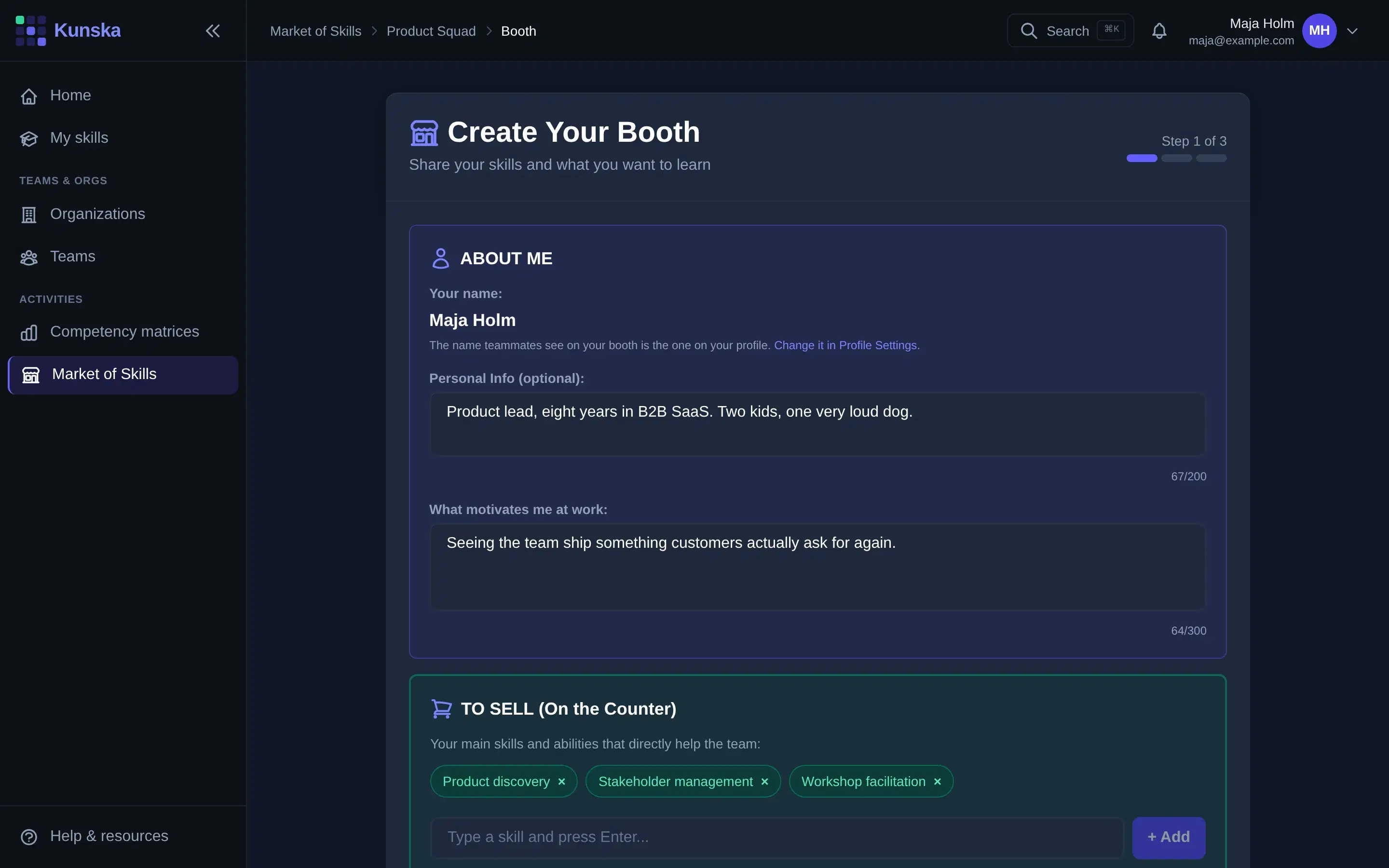
Everyone builds a booth with three lists, in their own words:
- To Sell — what I do well and would happily help a colleague with.
- May Be — I have done it, could do it again, but it is not my main thing.
- To Buy — what I want to learn next, ideally from someone here.
Walk around (or check in on the call) and nudge. The usual problems are modesty and narrowness: an expert listing three things, everyone listing only their job title. Ask “what do people come to you for?” and “what did you do before this job?”. Call time when most booths are complete — a booth does not have to be perfect to be presented.
3. Presentations (3–5 minutes per person)
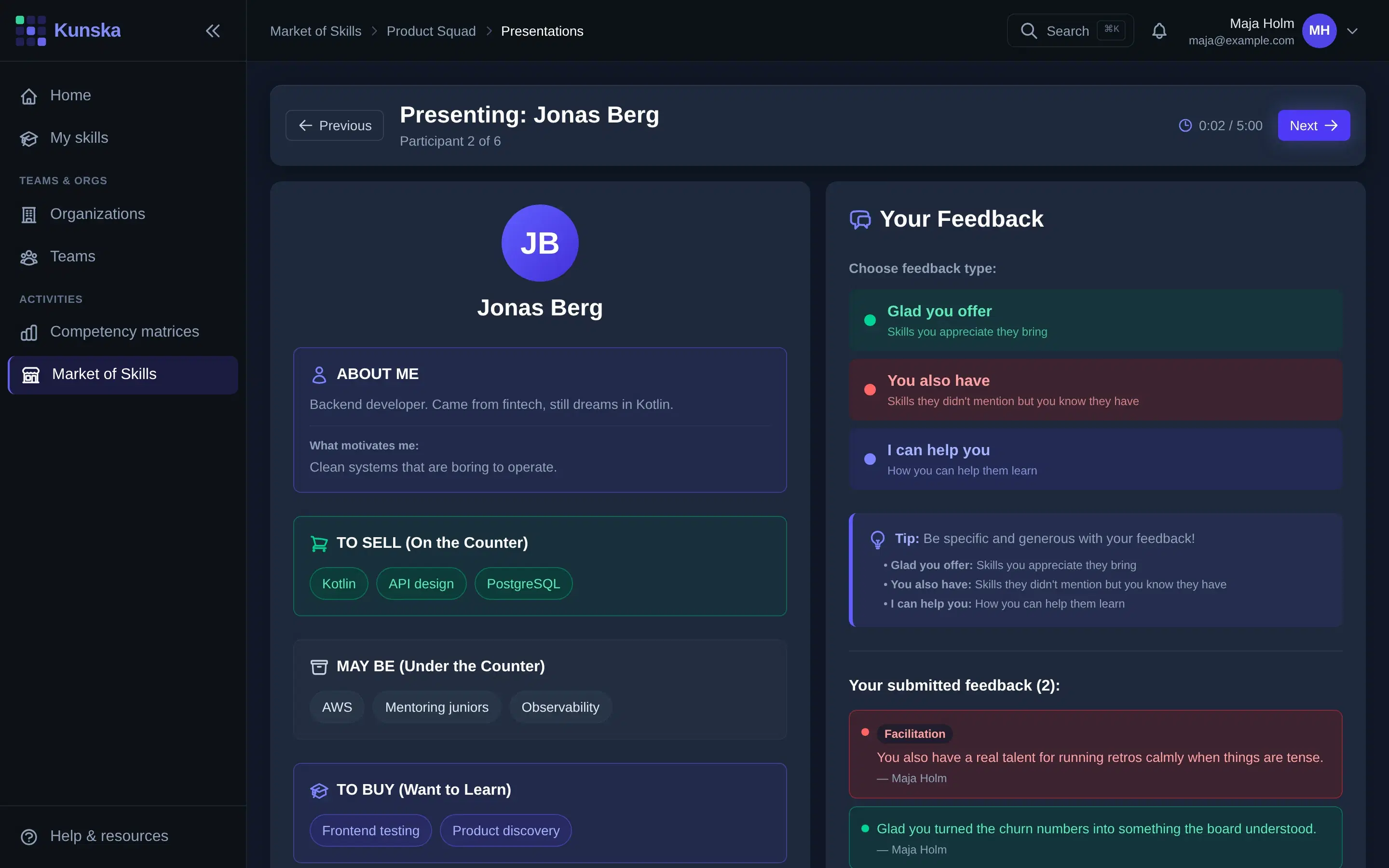
One at a time, each person walks the team through their booth. Keep it to about three minutes; a visible timer helps more than reminders. Then the room leaves feedback, in three kinds:
- Glad you offer — a skill on the booth the team is glad to have.
- You also have — a skill the presenter left out but colleagues have seen them use. This is the heart of the session; ask for it by name.
- I can help you — an offer to help with something on their To Buy list.
Model it on the first presenter: give one “you also have” yourself, specifically (“you ran the supplier negotiation last spring — that is negotiation”). Keep feedback about skills, never about performance. If anyone is uncomfortable giving feedback with their name on it, anonymous feedback can be switched on for the session.
4. Reflection (10–15 minutes)
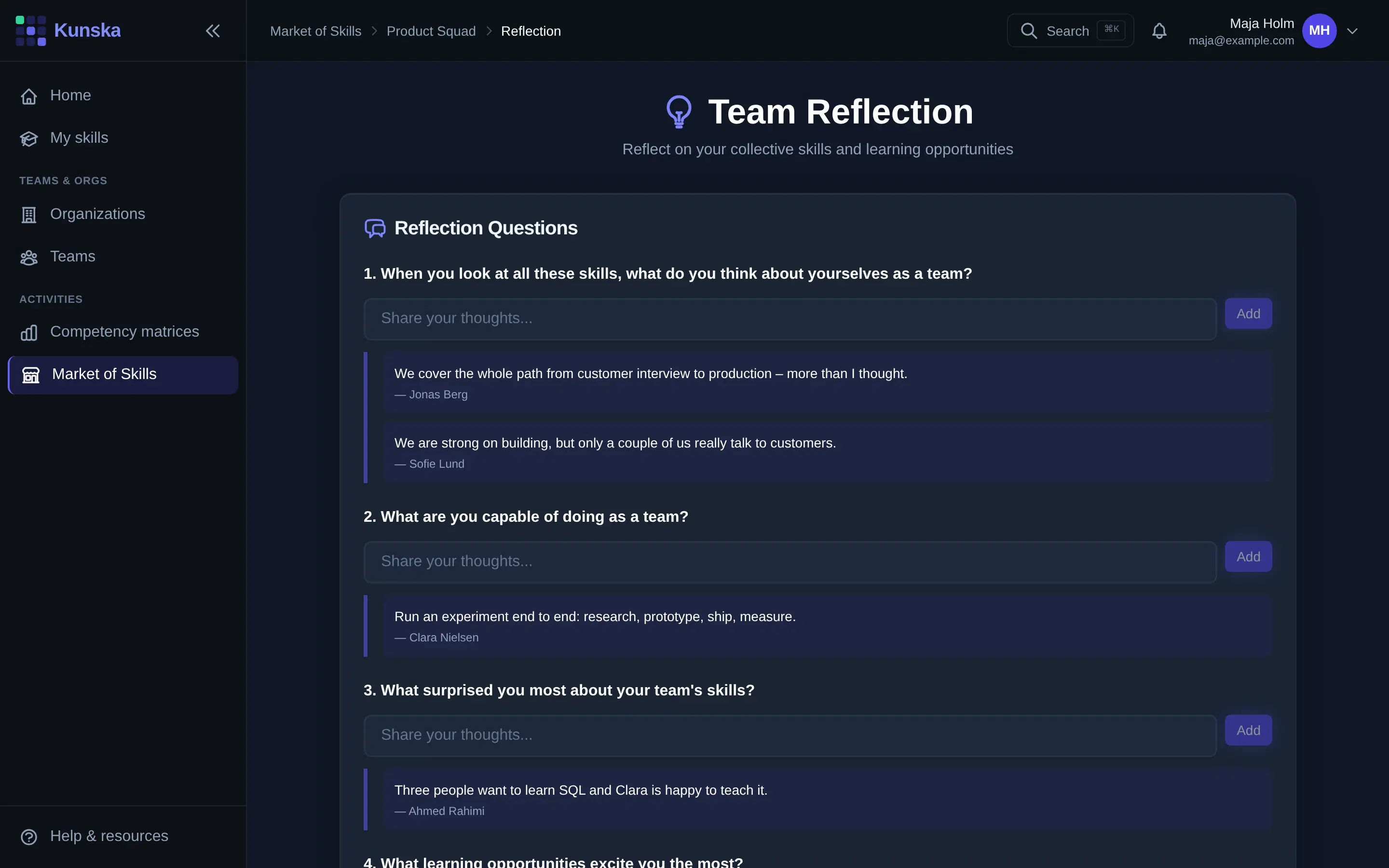
Now the team looks at itself, not at individuals. Kunska opens the reflection with four questions; use them or your own:
- When you look at all these skills, what do you think about yourselves as a team?
- What are you capable of doing as a team?
- What surprised you most about your team's skills?
- What learning opportunities excite you the most?
Let silence run a little. The surprises are usually the part people remember: the designer who used to be a teacher, the developer who speaks the language of your biggest new customer.
5. Close (5–10 minutes)
- Name two or three pairings before people leave: a To Buy that matches someone's To Sell. Agree the first hour together while the energy is there.
- Say what happens next: the session goes into the team's skills matrix, and you will run a short one again next quarter.
- Thank people for the “you also have”s. That is the part that took courage.
Afterwards: from session to matrix
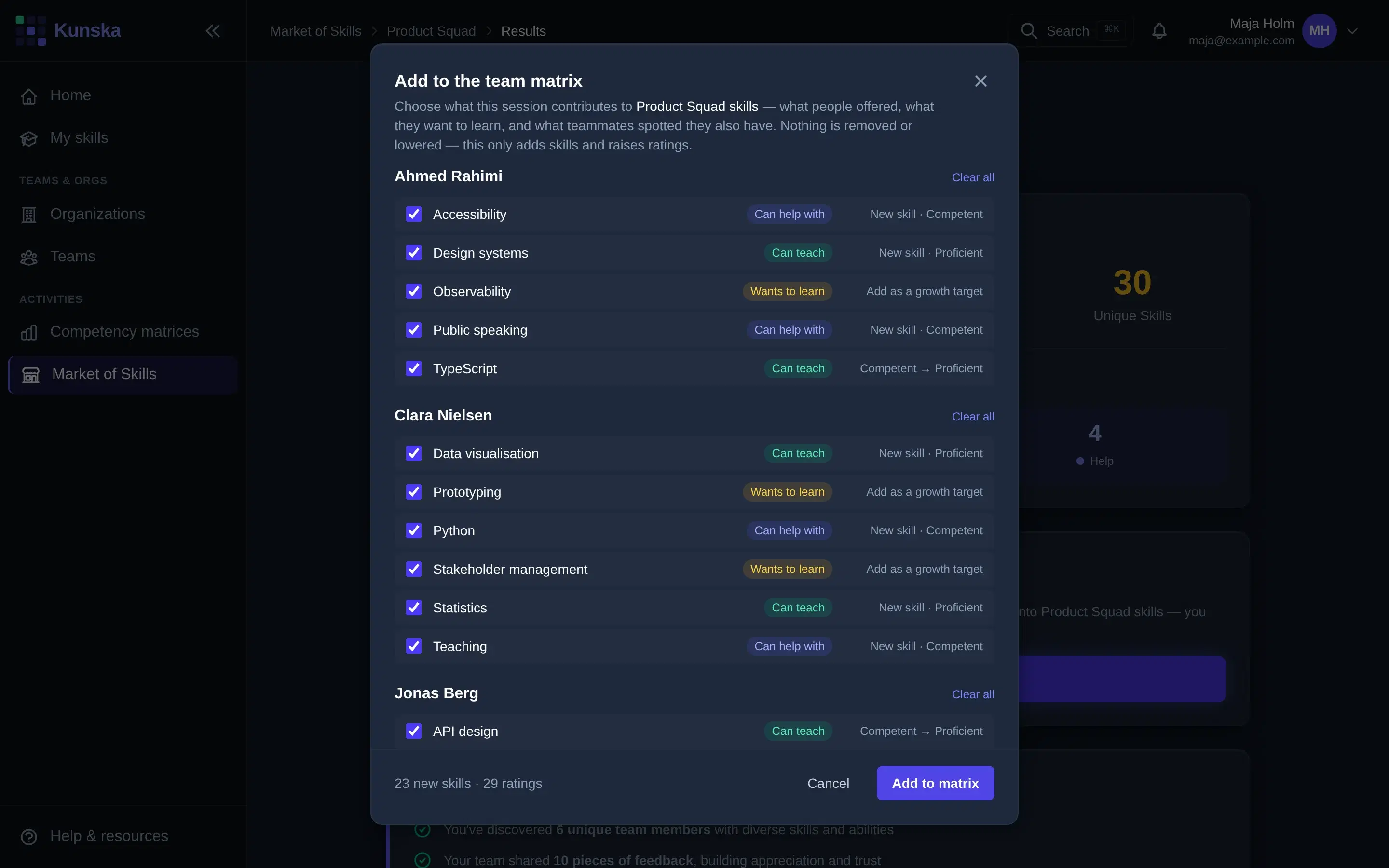
A session is only worth its output if the output is kept. Turn the booths into a skills matrix on the five-level scale:
- To Sell → Proficient (3)
- May Be → Competent (2)
- To Buy → a learning goal: the skill is added, the cell left unrated
- You also have → Competent (2), unless the person listed it themselves — their own account wins
Only add and raise; never lower a rating from a session. Then use the matrix: read its columns for a skills gap analysis, and give each person a development plan built from their skills.
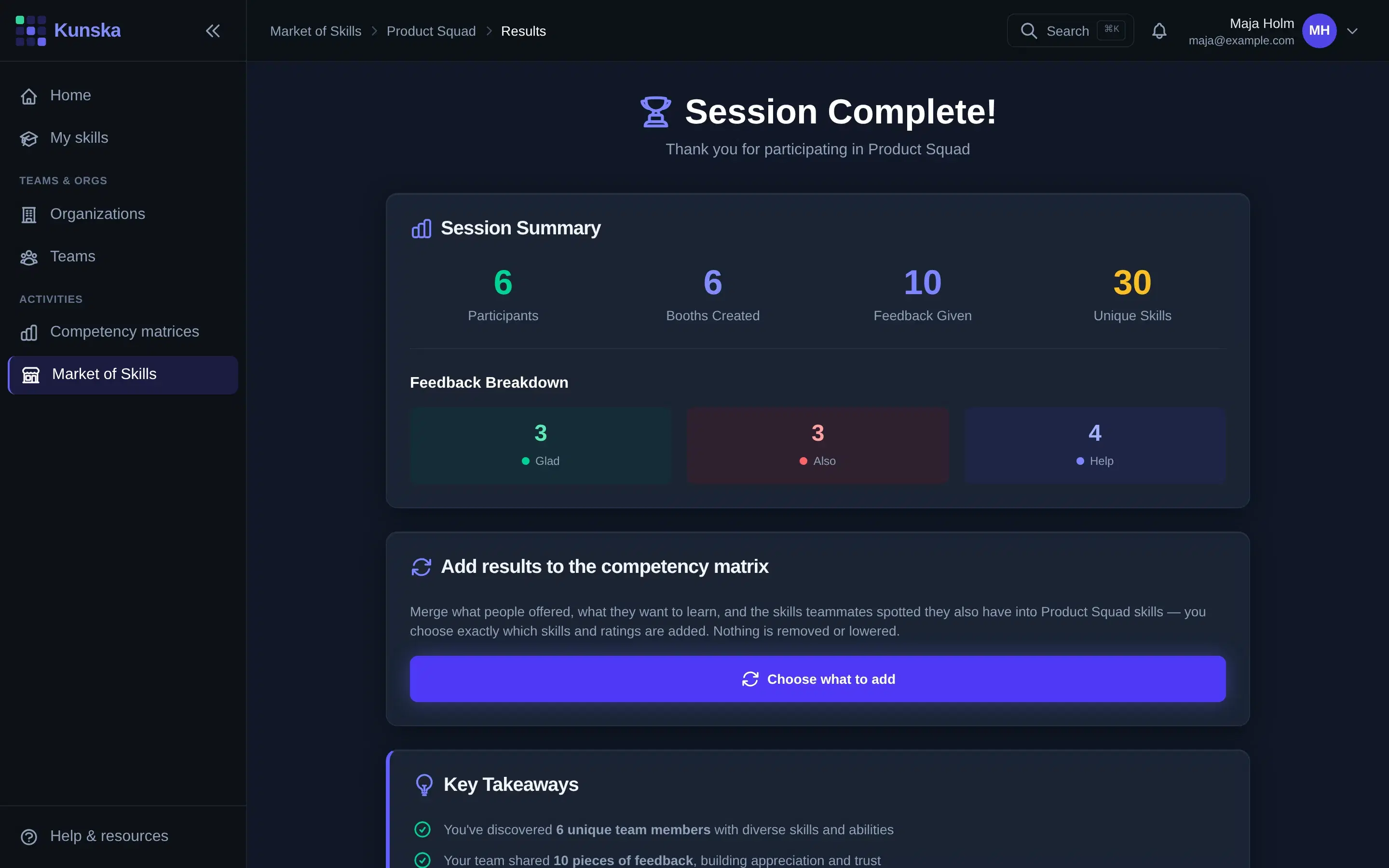
In Kunska this step is a dialog: the facilitator sees what each booth skill would do to the team's matrix — new, upgrade, already there — ticks what to include, and it is merged. Without Kunska, the templates use the same scale.
Common pitfalls
- Running over on presentations. The reflection is what gets cut, and it is the part people value most. Hold the timer.
- A manager who comments on everything. Ask the lead to give feedback last, or only “you also have”.
- Booths that are job descriptions. Ask for one skill per booth that has nothing to do with the person's role.
- Nothing happens afterwards. If the matrix is not updated within a week and the pairings do not meet, the next session will be harder to fill.
Run it in Kunska
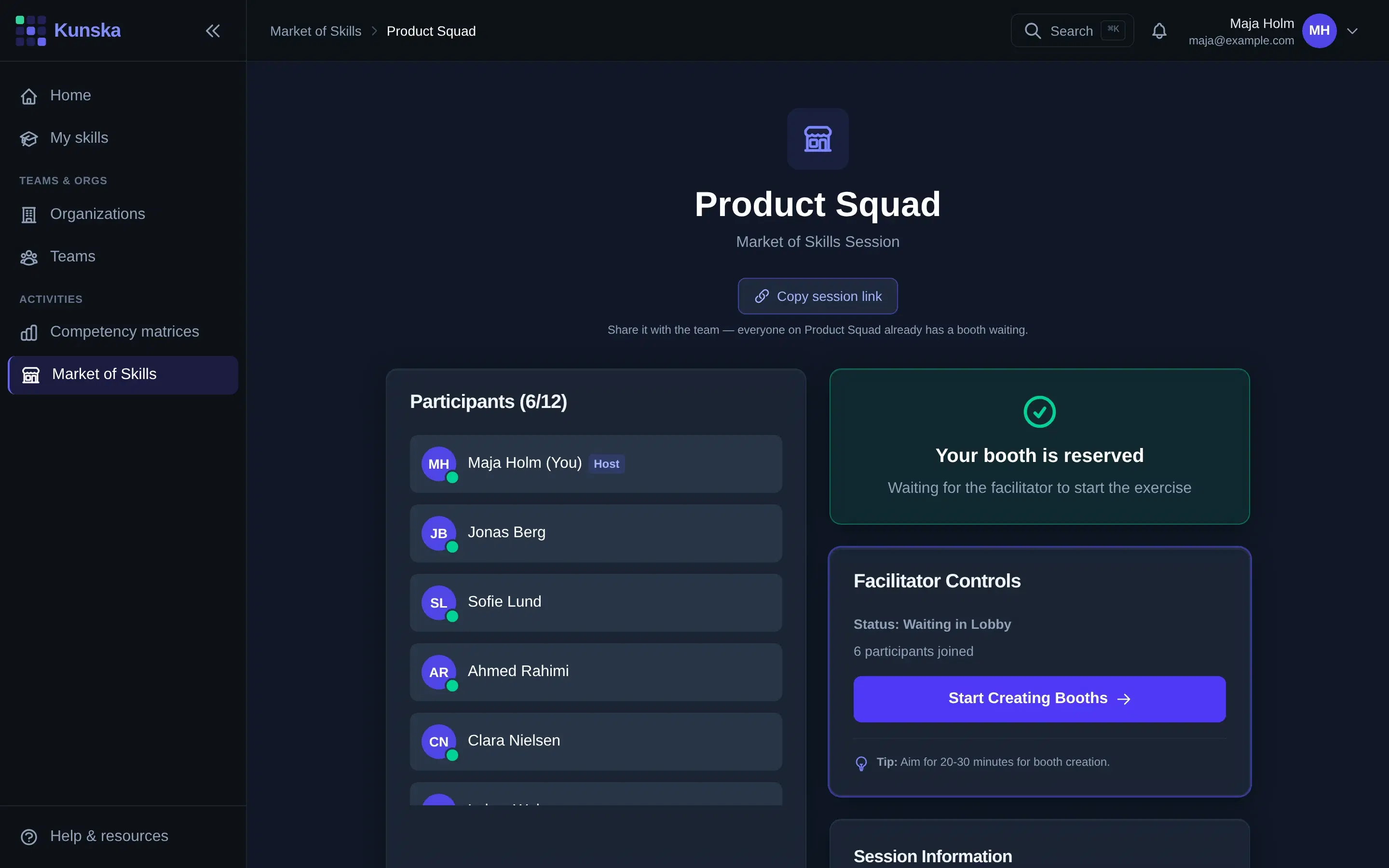
Start a session from your team's page: everyone on the team is invited, the facilitator moves the room from stage to stage and every screen follows, and the result merges into the matrix. Free for teams.